Modeling Residual Stress from Heat Treatment
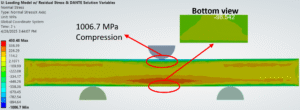
Residual stress, carbon profile, and phase volume fractions are all important considerations when modeling a loading condition for a steal part after heat treatment. ANSYS
Residual stress, carbon profile, and phase volume fractions are all important considerations when modeling a loading condition for a steal part after heat treatment. ANSYS
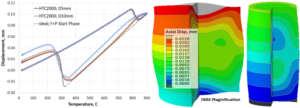
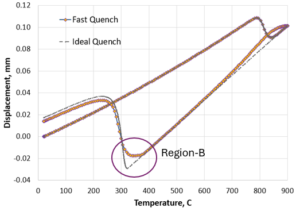
The dilatometry sample size and the quenching rate affect the measured dilatometry curve and the final sample dimension. With a fast quench rate, the simulated

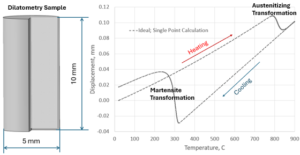
When a dilatometry sample cools to the martensite start temperature (Ms), martensite transformation starts with an expansion. The amount of volume expansion is used to

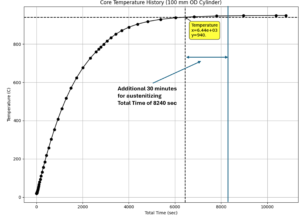
Modeling can be a powerful tool for designing various aspects of the heat treatment process. One application is to design the heating time required for

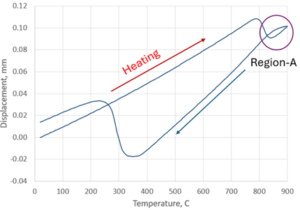
At the beginning of quenching, in a dilatometry test using a dilatometer, temperature uniformity often leads to inaccuracies in the recorded strain data, as seen

Heat Treatment of steels involves phase transformations: 1) initial phases transform to austenite 2) austenite transforms to diffusive phases or martensite during quenching. A dilatometry