
Material Characterization Using Dilatometry Tests


Heat Treatment of steels involves phase transformations: 1) initial phases transform to austenite 2) austenite transforms to diffusive phases or martensite during quenching. A dilatometry test using quenching dilatometer is often using to characterize the phase transformation behavior of steels for computer modeling to understand heat treatment problems such as distortion, quench cracks, and incorrect hardness.
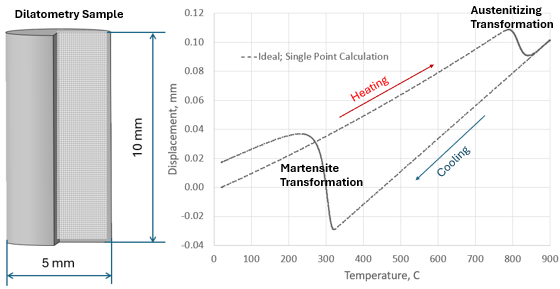
A small sample is used for dilatometry tests to minimize the temperature difference in the sample. The dilatometry curve shown is calculated from the DANTE material database. The curve provides valuable information such as: 1) coefficient of thermal expansion for different phases 2) phase transformation strains 3) austenite and martensite transformation temperature and rates.


Student/Trial License

Learn heat treatment. Explore simulation.

Start with the DANTE Student’s Guide to Heat Treating, a quick reference covering the fundamentals of heat treatment, steel microstructures, and common processes. Ready to go further? Get hands-on experience with DANTE through our student/trial license and explore real-world heat treatment simulations.

resources

Research Ft DANTE

Explore published articles from professionals who’ve used DANTE in their scientific research.

Talk with our experts

Have a project or a question about heat treating? Connect with our engineers for to discuss how DANTE can fit into your workflow.

DANTE latent heat during austenitizing

tools for heat treatment modeling

See how the DANTE suite enables engineers to simulate quenching, distortion, hardness, stress, and metallurgical phases

Proven industry results

Explore our case studies showing how DANTE FEA predicts distortion, hardness, phase changes, and residual stress.