
Design and optimize heat treatment processes to achieve target hardness, minimize distortion, and solve cracking and heat-treat related failures
Projects Finished
Publications
Years of Experience
Discover the tools engineers use to reduce distortion, improve performance, and solve failures by optimizing and designing heat treatment recipes.
DANTE Solutions delivers industry-leading heat treatment simulation software to predict distortion, residual stress, phases, and hardness before production. Our technology enables manufacturers to design and optimize heat treatment processes, reduce scrap and rework, prevent cracking, and solve complex heat-treat related failures before they reach the shop floor. In addition to powerful software, we provide expert consulting and responsive technical support to help you overcome heat treatment challenges and improve part performance with confidence.
Over the past few years, I have been using Dante software to model various heat treat processes for automotive combustion engine components. The software has provided valuable insight to the complicated physics that govern induction hardening and carburizing processes. Dante has also been a useful tool for optimizing heat treat recipes, much more quickly than possible with physical testing. Furthermore, I can rely on the Dante team to provide fast, capable assistance to work through any technical issues that arise. I have also worked with Dante on a couple of significant software development projects, and they have always demonstrated a high level of professionalism and efficiency. I look forward to continuing to use Dante for current and future applications.
DANTE® Heat Treat Simulation Software has been a great boon to Cummins. Since we started using their software we have gone through several projects that have increased our understanding of heat treatment and some of which that have saved us production costs. One example was enabling us to gain the leverage needed to make a material and process change on a legacy product that is now saving us at least 25% on material costs. The team at DANTE Solutions has always been very accommodating and is very quick to give assistance and feedback whenever troubles arise, even when the troubles are caused by other parts of the simulation and not DANTE itself. I look forward to working with the DANTE team in the coming years as we expand our list of engineers who use this software.

















Get expert support for solving complex heat treating challenges. Our team uses DANTE heat treatment simulation software, metallurgical expertise, and real-world experience to help you improve processes, reduce distortion, and increase part performance.

For generations, heat treaters have used a simple rule of thumb to estimate how long a part needs to soak in a furnace before it reaches temperature: Heating a cold part placed in a hot furnace takes about one hour per inch of section thickness to reach temperature.
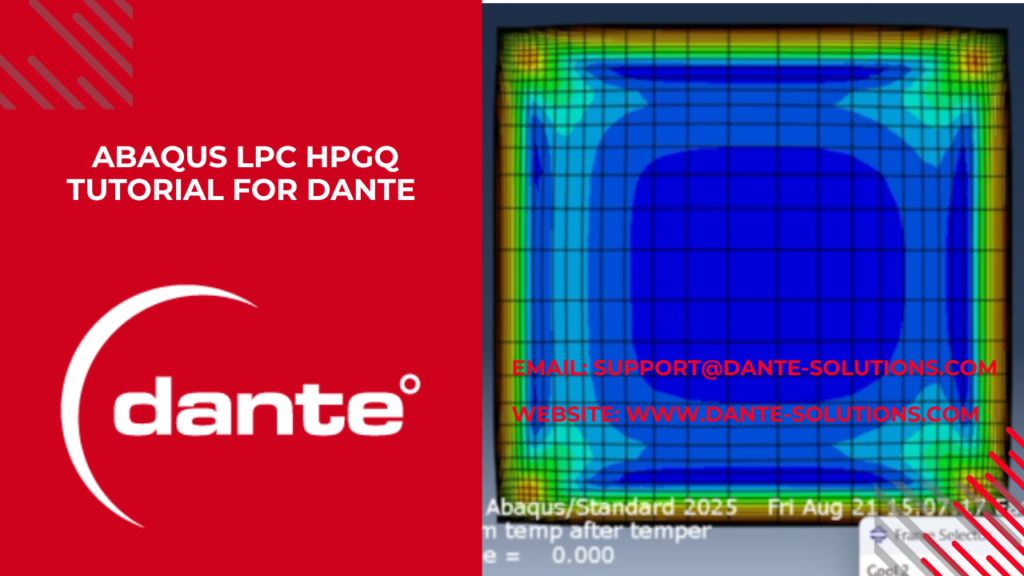
In this DANTE tutorial, we go through creating a low-pressure carburization heat treatment with a high-pressure gas quench simulation inside Abaqus CAE coupled with DANTE Model Builder.
Using an axisymmetric ring slice model, this tutorial demonstrates the entire process from importing geometry

Learning heat treatment?
Download our DANTE Student Heat Treat Cheat Sheet for a quick reference to the fundamentals of steel, microstructures, heat treating processes, and common terminology.
Backed by over 40 years of experience in consulting and overcoming heat treatment challenges, DANTE Solutions delivers the industry leading heat treatment simulation software that predicts distortion, residual stress, phase transformation, and hardness before production.
The student/trial license includes:
This version is designed to help users become familiar with DANTE’s modeling environment and supporting tools before upgrading to a full commercial license.
Yes. Experiments will be needed to characterize the phase transformation kinetics, mechanical properties, and thermal properties for heat treatment simulation. The extent of the experiments will be determined by several factors:
DANTE can model most case hardening, thermal, and quench hardening processes. Some case hardening processes include low pressure and gas carburization, gas nitriding, induction, flame, and laser hardening. Quench hardening processes such as immersion into oil, water, or polymer, high pressure gas quenching, press/fixture quenching, and spray quenching. Some other processes that can be modeled include cryogenic treatment, tempering, precipitation hardening, martempering, austempering, normalizing, and annealing. This is not an exhaustive list, so if you have a process that is not listed, contact us. We love to model new and interesting process.
Yes. The format is determined by either ANSYS or ABAQUS, depending on which solver you are using in conjunction with DANTE. We have used Joule heating as a function of time from several different electromagnetic modeling software packages and stress profiles from forming and casting softwares.
DANTE results can also be used as inputs or initial conditions to other models. Most common is the use of the residual stress from heat treatment as an initial condition to loading or fatigue models. The format again is determined by the FE solver being used for the loading or fatigue models. The version of DANTE linking to ANSYS includes a convenient post processing tool that allows for the generation of a file that writes the residual stress tensor as a function of Cartesian coordinates to a text file, which is then read back into ANSYS Mechanical for loading models.
Yes. The phase transformation models can properly account for the transition of martensite to tempered martensite. The mechanical model can account for the mechanical property differences between martensite and tempered martensite. The mechanical model can also account for the relaxation of residual stress as carbides precipitate out of the martensite matrix.
High temperature tempering is now also available in DANTE. This model works well for secondary hardening steels, as well as a model for the fast heating rate, short time induction tempering process. These models also account for volume shrinkage seen at tempering temperatures above 300 degrees Celsius.
By simulating the heat treatment process, manufacturers can accurately predict the properties and characteristics of their metals and optimize their production processes, reducing labor costs, accidents, and unwanted results.