
Importance of Dilatometry Sample Design


At the beginning of quenching, in a dilatometry test using a dilatometer, temperature uniformity often leads to inaccuracies in the recorded strain data, as seen in Region A in the figure below.
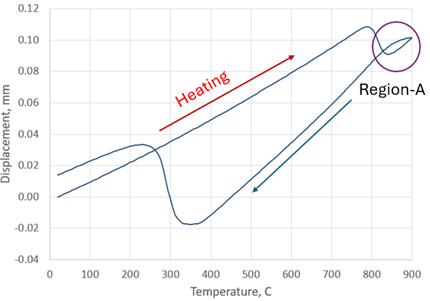
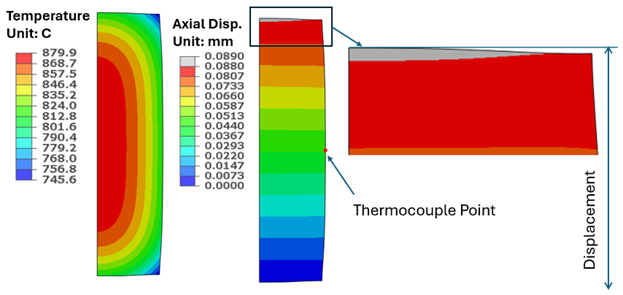
The sample is cooled from both the outer diameter (OD) and the end surfaces. A higher quenching rate increased the data inaccuracy as demonstrated by modeling in the figure below. The dilatometry displacement is measured from the largest distance between the end faces of the cylinder, and the temperature is taken from the middle of the OD surface. Proper selections of the dilatometry sample size and cooling rate are for the accuracy of the dilatometry data.


Student/Trial License

Learn heat treatment. Explore simulation.

Start with the DANTE Student’s Guide to Heat Treating, a quick reference covering the fundamentals of heat treatment, steel microstructures, and common processes. Ready to go further? Get hands-on experience with DANTE through our student/trial license and explore real-world heat treatment simulations.

resources

Research Ft DANTE

Explore published articles from professionals who’ve used DANTE in their scientific research.

Talk with our experts

Have a project or a question about heat treating? Connect with our engineers for to discuss how DANTE can fit into your workflow.

DANTE latent heat during austenitizing

tools for heat treatment modeling

See how the DANTE suite enables engineers to simulate quenching, distortion, hardness, stress, and metallurgical phases

Proven industry results

Explore our case studies showing how DANTE FEA predicts distortion, hardness, phase changes, and residual stress.