Low Pressure Carburization Process Improvement for a Ring Gear
Low pressure carburization (LPC) processes are becoming more widespread throughout industry due to the reduced cycle times and the control over the carbon profile through the case. Unlike gas carburization, which utilizes a constant carbon potential to maintain the available carbon on the part surfa
Liquid quenching of long steel components can introduce significant distortion if the component is not lowered into the liquid quench bath properly. Whether the liquid quenchant is oil, water, or a polymer solution, the angle and rate of immersion can have a significant effect on the final distortio
Distortion Minimization of a Press Quenched Bevel Gear
A combination of carburization and quench hardening is often used to increase the strength and improve fatigue performance of steel parts. During quenching, stresses caused by the thermal gradient and phase transformations will generate plastic deformation, which will lead to distortion in hardened
Distortion Analysis of Landing Gear during Oil Quench
Large distortions after oil quenching in the following distortion modes:
Bow in XY-Plane.
Bow in YZ-Plane.
Straightness of a Blind Hole.
All distortion modes shown in the figures make assembly of the entire structure very difficult.
Immersion into the oil tank is the main focus of the distortio
Axle shafts are typically case hardened using an induction process by rapidly heating to the material’s austenitizing temperature through the desired case depth. The shaft is then quenched to form martensite, leaving the surface harder than the base material and under a desirable, compressive residu
Quench and temper hardening of a large high speed steel rolling mill roll requires optimizing depth of hardening and inprocess thermal gradients to maximize surface compression and minimize internal tensile stresses that increase likelihood of internal cracking. Model was developed to determine opti
Oil Hole Crack of Crankshaft During Induction Hardening
Cracking at oil holes on pin and main bearing sections of crankshafts during induction hardening occurs due to thermal stress during spray quenching. The problem arises due to the angle of the hole and the nonuniform mass distribution.
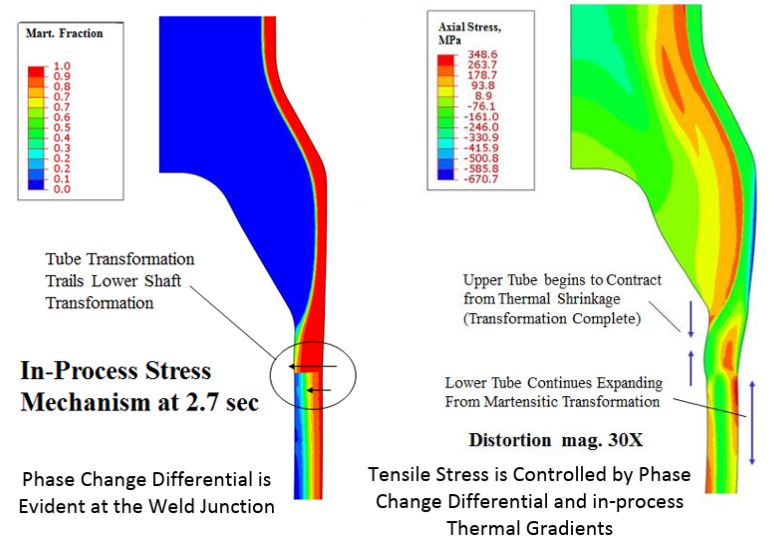
In-process tensile stress in an induction hardened 4130/10B37 welded tube shaft was investigated. Thermal and transformation stresses during heat treatment were examined to determine source of bond line cracking and potential remedies.
Helicopter transmission life limits load carrying capacity and acceleration. Improved gear bending fatigue life will allow heavier loads and improved acceleration. New designs are costly and require long development times. A process improvement for an existing design saves time and money.
Get hands-on experience with DANTE. Our student and trial license offers full access to heat treatment modeling tools so you can learn, experiment, and explore real-world simulations.