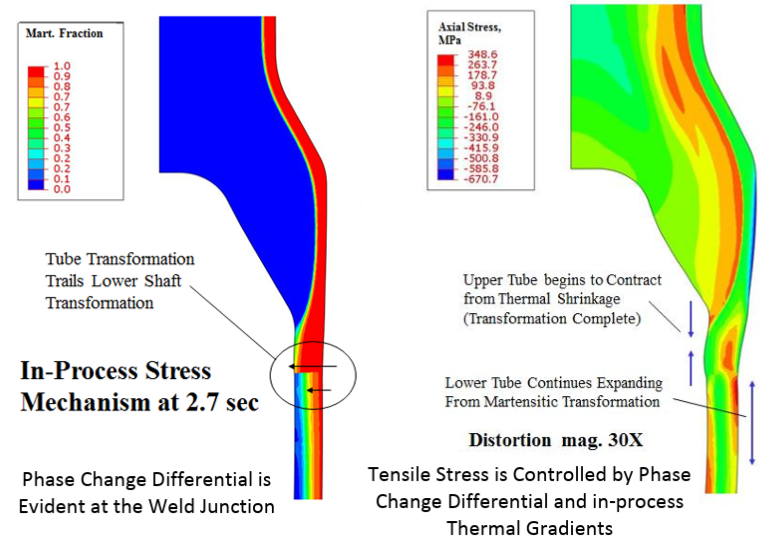
In-process tensile stress in an induction hardened 4130/10B37 welded tube shaft was investigated. Thermal and transformation stresses during heat treatment were examined to determine source of bond line cracking and potential remedies.
Process Description
A 4130 steel tube is welded to a 10B37 shaft. The tube and shaft assembly are then induction heated and quenched to heat treat the assembly. Surface and internal in- process stresses are developed as a result of thermal gradients, mass differential, and phase transformation.
Benefits
DANTE is used in conjunction with traditional metallurgical engineering to evaluate locations of high local stress intensity. Modeling showed the benefit of modified heating coil design and reduced quench severity in reducing local in-process tensile stresses.
Get hands-on experience with DANTE. Our student and trial license offers full access to heat treatment modeling tools so you can learn, experiment, and explore real-world simulations.