Liquid quenching of long steel components can introduce significant distortion if the component is not lowered into the liquid quench bath properly. Whether the liquid quenchant is oil, water, or a polymer solution, the angle and rate of immersion can have a significant effect on the final distortion. Heat-treatment simulation software can provide insight into how a long component will behave during heat-treatment, but only if the immersion process is simulated. The simulation of relatively small steel components assumes that the entire part enters the quench bath simultaneously. This assumption is valid for most bearing rings, gears, etc., since the entire part is submerged within the quenchant in a fraction of a second. However, the assumption begins to lose its validity when applied to relatively long parts.
To show the significance of simulating the immersion process during quench hardening of relatively long steel components, a 500 mm long, 12 mm diameter steel bar made of AISI 9310 was constructed and meshed in Ansys and the heat-treatment process was modeled using the heat-treatment simulation software DANTE. Several immersion rates were compared to a bar that was instantly lowered into the quenchant as well as a comparison between gradually lowering the bar into the quenchant vertically and horizontally.
Geometry and Model
Model Description:
Material: AISI 9310
Bar length: 500 mm
Bar diameter: 12 mm
Process Description:
Several scenarios were investigated to evaluate the effects of immersion parameters on the bow distortion of the bar
Instantly immersed
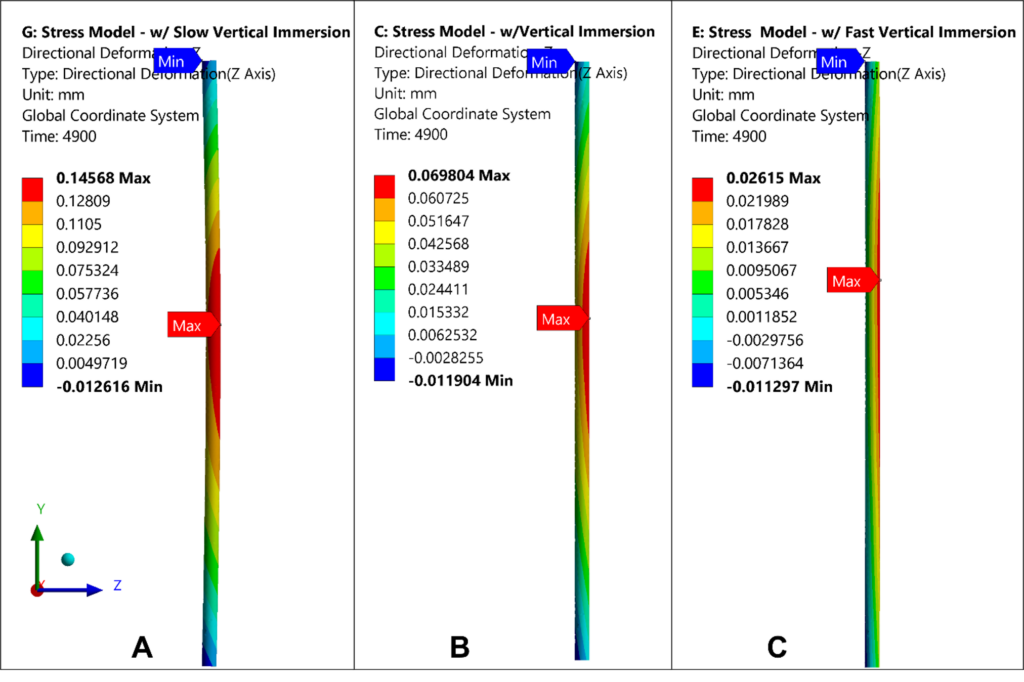
Vertical immersion rate of 2.5 mm/s
Vertical immersion rate of 5.0 mm/s
Vertical immersion rate of 10.0 mm/s
Horizontal immersion rate of 1.0 mm/s
An algorithm in DANTE determines the location of the component relative to the quenchant surface and applies a defined air heat transfer coefficient (HTC) to the part surface above the quenchant surface and a defined liquid HTC to the part surface below the quenchant surface.
Immersion Input Parameters
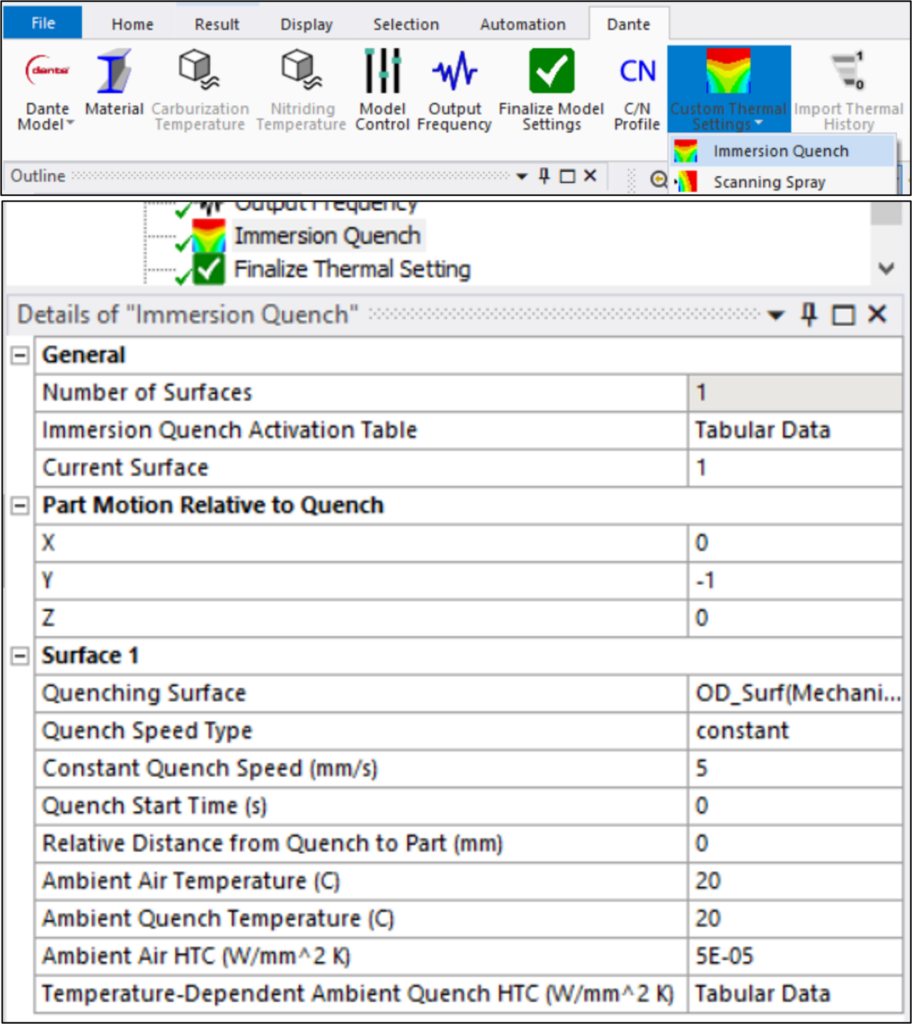
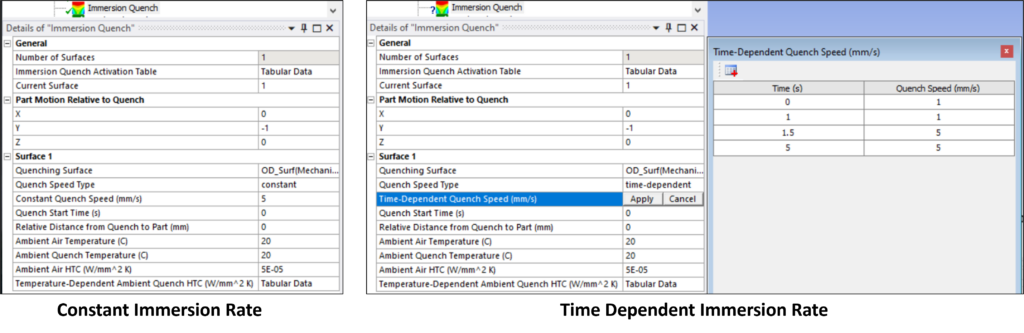
DANTE makes setting up an immersion process simple by adding a Custom Thermal Setting-Immersion Quench object from the DANTE ACT and entering the process specific parameters.
Modifiable immersion parameters in DANTE include:
Number of surfaces subjected to different parameters; this is useful if blind holes or other geometric features influence the flow of quenchant around the part
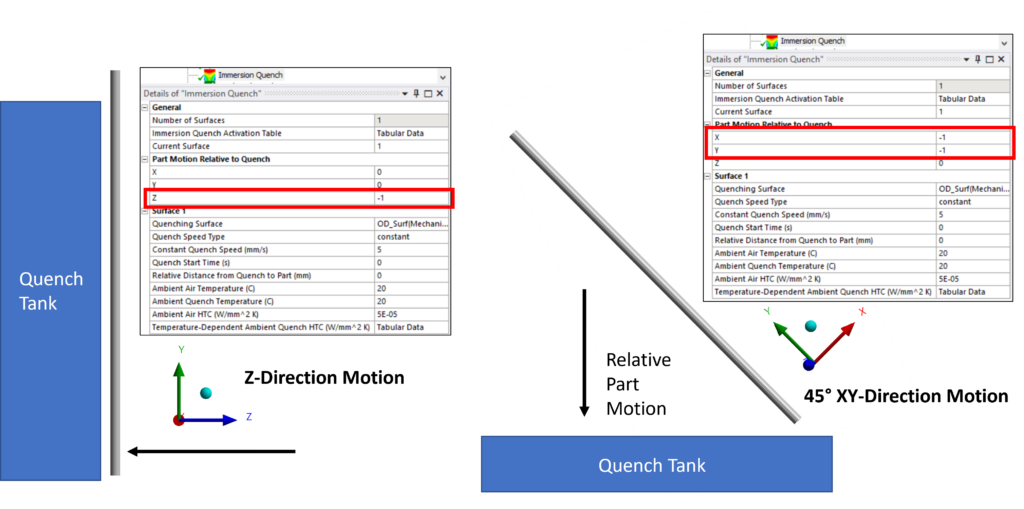
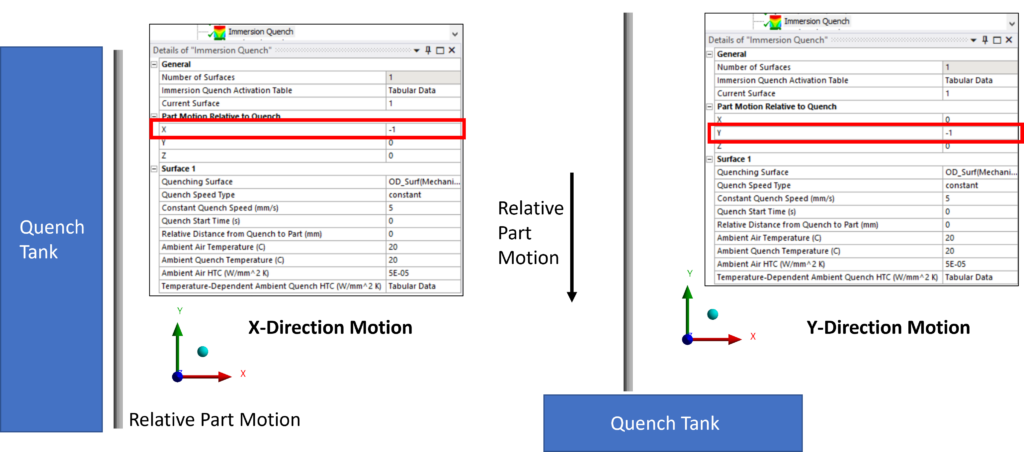
Immersion direction; the immersion direction can be any angle, regardless of model orientation, with respect to the global coordinate system
Immersion rate; the rate can be defined as a constant or as a function of time
Heat transfer coefficient and ambient temperature of the air above the quenchant (both are constant) and the quenchant (ambient is constant, HTC is a function of part surface temperature)
Bow Distortion Comparison
No Immersion (A) vs. Immersion (B)
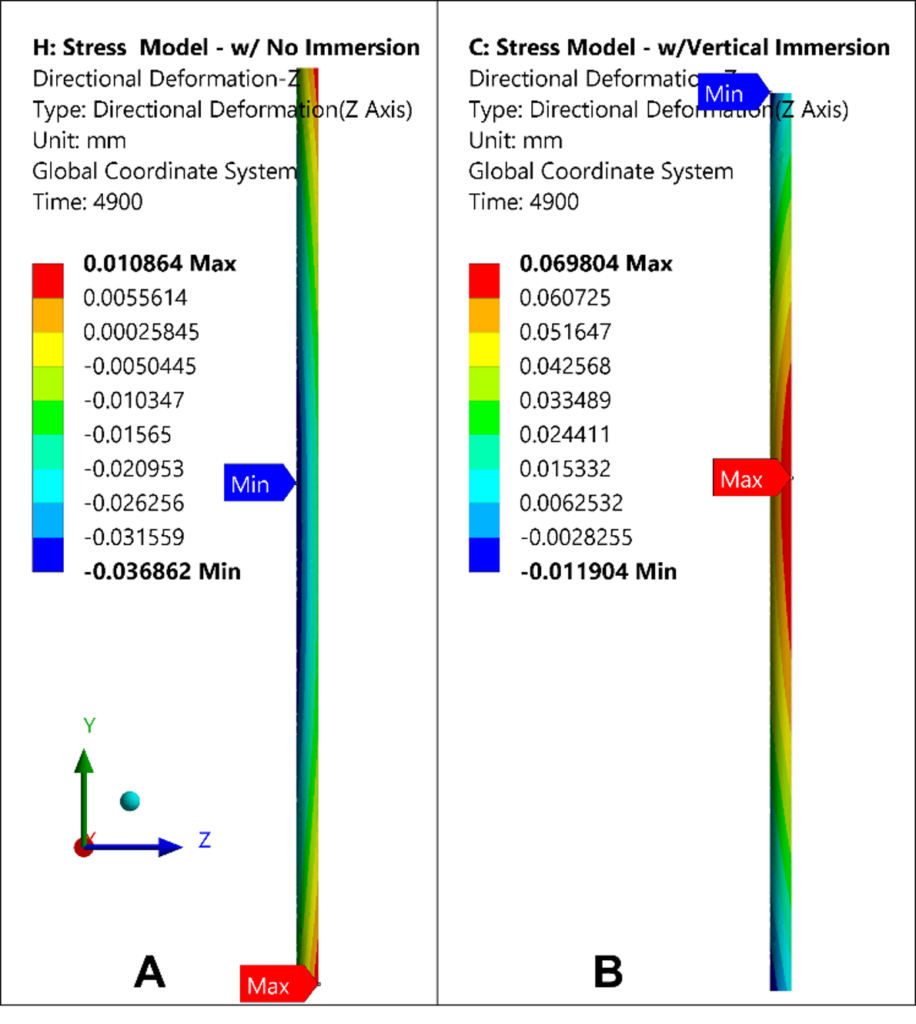
Predicted bow distortion shown for a simulation NOT considering immersion (A) and a case which DOES consider immersion (B)
Without considering immersion, the part is considered to be instantaneously submerged below the quenchant surface
The immersion rate used in this example was 5 mm/s; meaning the 500 mm long component is fully immersed in 100 seconds
The bow magnitude is twice as much when immersion is considered
Bow distortion exists in the No Immersion case due to the ends’ effect on cooling uniformity
The bow direction between the two cases is opposite
If immersion is ignored for this component and process, not only is the magnitude significantly underpredicted, but the direction of bow is incorrect
Axial Distortion Comparison
No Immersion (A) vs. Immersion (B)
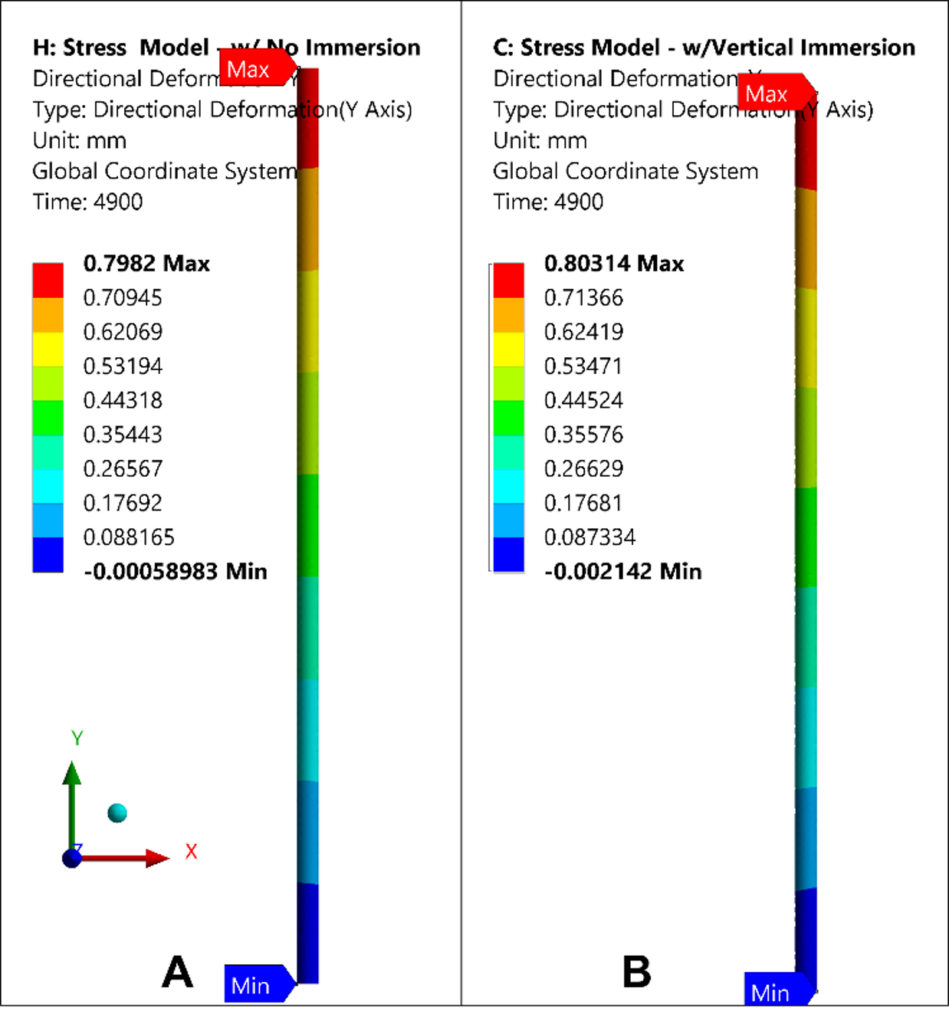
Predicted axial distortion shown for a simulation NOT considering immersion (A) and a case which DOES consider immersion (B)
Without considering immersion, the part is considered to be instantaneously submerged below the quenchant surface
The immersion rate used in this example was 5 mm/s; meaning the 500 mm long component is fully immersed in 100 seconds
The axial distortion magnitude is equivalent between the two cases
This will generally be true when the bow distortion is a full magnitude or more less than the axial distortion, as it is with this case
Axial dimensional change is generally determined by the volumetric difference between the initial and final microstructure
Whereas bow distortion is generally determined by nonuniform heating/cooling conditions, which can be a result of processing conditions or geometry
Residual Stress Comparison
No Immersion (A) vs. Immersion (B)
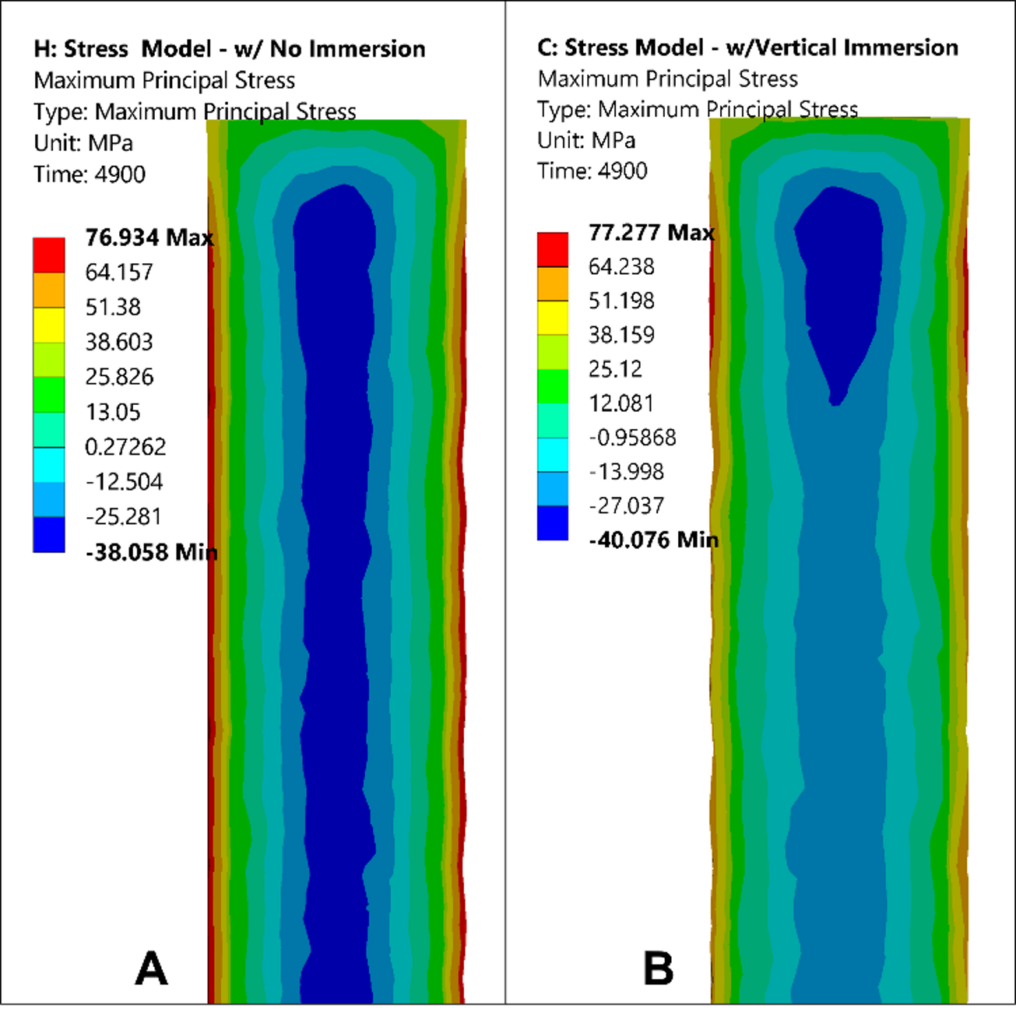
Predicted residual maximum principal stress shown for a simulation NOT considering immersion (A) and a case which DOES consider immersion (B)
Without considering immersion, the part is considered to be instantaneously submerged below the quenchant surface
The immersion rate used in this example was 5 mm/s; meaning the 500 mm long component is fully immersed in 100 seconds
The residual stress magnitude and distribution is equivalent between the two cases
This will generally be true if the final phase distribution is equivalent between the two processes being evaluated
Residual stress is mainly determined by the volumetric difference between the initial and final microstructure
Immersion Rate Definition
DANTE has the capability to model different immersion rates
Constant or Time-Dependent immersion rates can be applied to the model
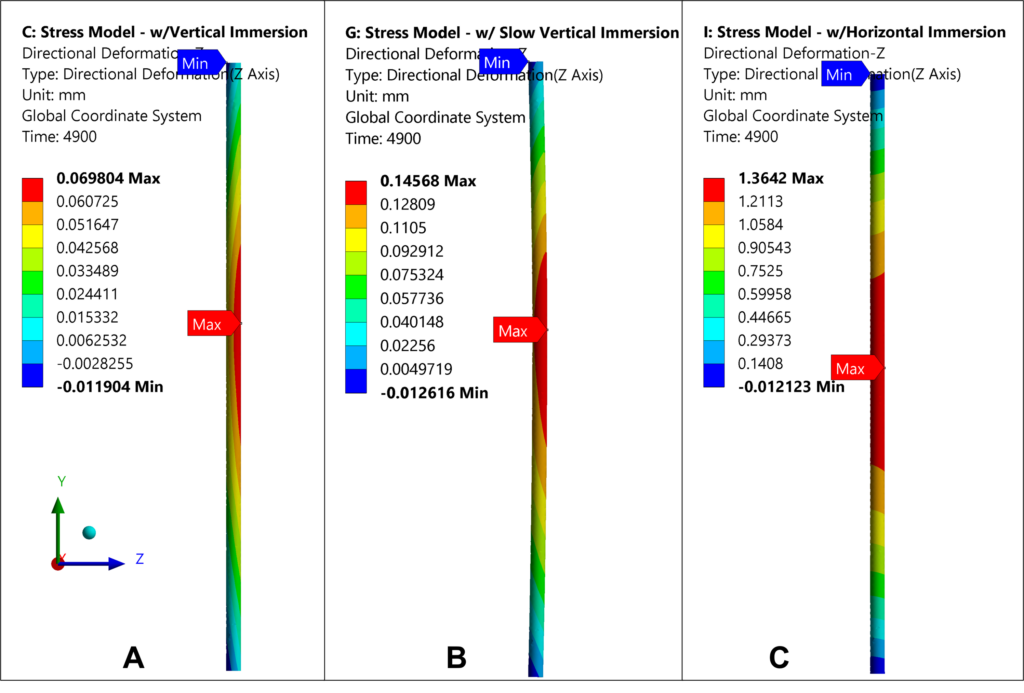
Two immersion directions were modeled to show the effects on distortion
Generally, long components are immersed vertically (long axis normal to the quench tank) and not horizontally
The modeling results for two vertical immersion cases (5 mm/s (A) and 2.5 mm/s (B)) are compared to a horizontally immersed component (1 mm/s) (C)
The horizontally immersed bar has a full magnitude greater bow distortion than the vertically immersed bar with the slowest immersion rate
Summary
Simulating the immersion process of long steel components being quench hardened is now easily handled by DANTE linking with ANSYS
Immersion parameters can be easily modified, including the immersion rate (constant or time dependent), any delays before immersion begins (time or distance), ambient temperatures for the air above the quenchant and the quenchant (constant only), and HTCs for the air above the quenchant (constant) and the quenchant (function of part surface temperature)
The effect of immersion on bow distortion was shown to be significant, when compared to not considering the immersion process in the simulation
The effect of immersion on the axial distortion and residual stress was shown to be equivalent to a case not considering immersion
The equivalency of axial distortion and residual stress is not guaranteed, as it is dependent on the steel grade, processing conditions, and geometry
The effect of the immersion rate on bow distortion was shown to be significant for the component and conditions modeled
The effect of the immersion direction on bow distortion was shown to be significant for the component and conditions modeled
Get hands-on experience with DANTE. Our student and trial license offers full access to heat treatment modeling tools so you can learn, experiment, and explore real-world simulations.