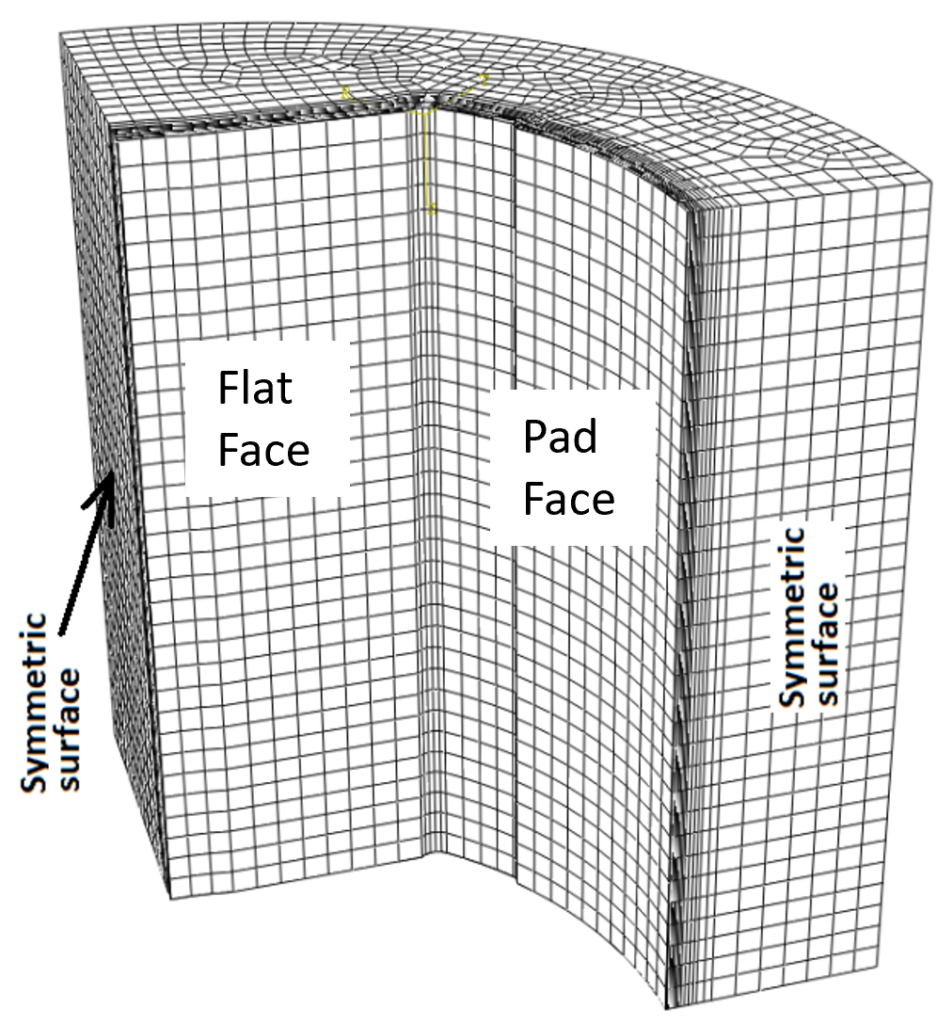
Casing components experienced cracking problems during an induction hardening process. The casing has an OD of 32 inches and is 20 inches tall. The CAD model of the component, as well as the region of high cracking potential, is shown in the figure. DANTE Heat Treatment Simulation software was used to investigate the induction hardening process to identify reasons for cracking and to determine a process modification to eliminate the cracking problem.
Model & Process Description
The steel is AISI 4340
Case depth is 0.160 inches
DANTE does not model the physics of the electro-magnetic field. Power distributions as functions of time and geometry predicted from tools such as ELTA or Flux can be imported to drive the DANTE model. For this project, power distributions were estimated from DANTE Solutions’ past modeling experience.
A brief description of the original induction hardening process is described below:
Width of inductor: 4.0 in.
Inductor travel speed: 0.12 in/sec.
Dwell between inductor and spray (flat face): 0.979 in.
Dwell between inductor and spray (pad face): 1.166 in.
The corner between the flat and pad faces is not directly spray quenched. However, because of overflow of the quenchant, the corner was assumed to be quenched with a time delay and milder rate.
The dwell distance for the corner water front was estimated to be 2.166 inches below the inductor, with half of the heat transfer coefficient that was applied to the flat and pad faces.
Results: Original Process
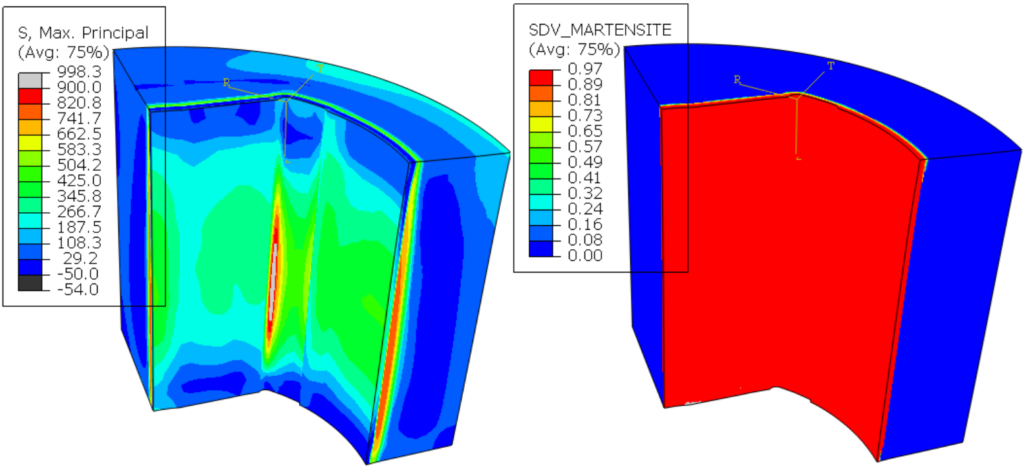
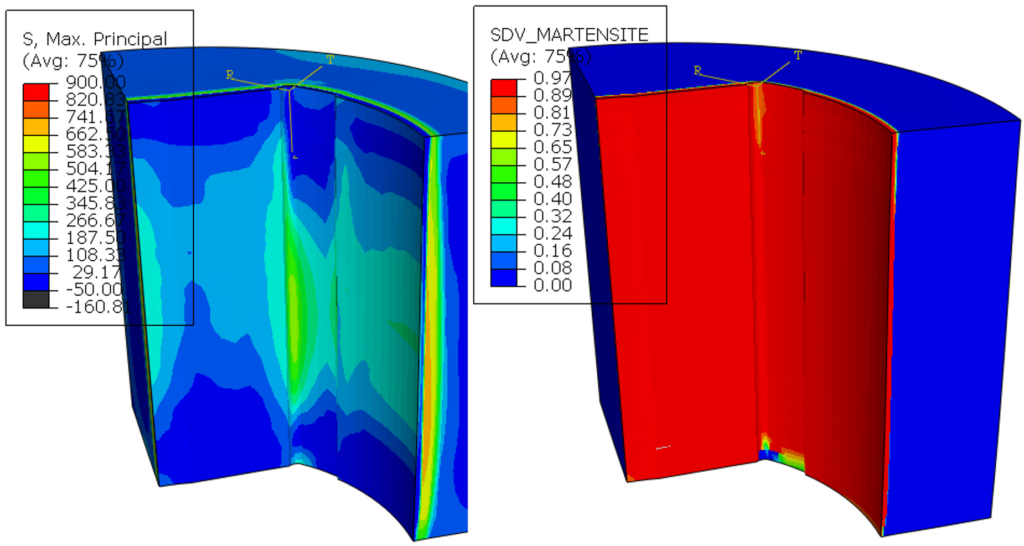
Figures show Maximum Principal stress (top-left) and Martensite phase fraction (top-right) at the end of quenching
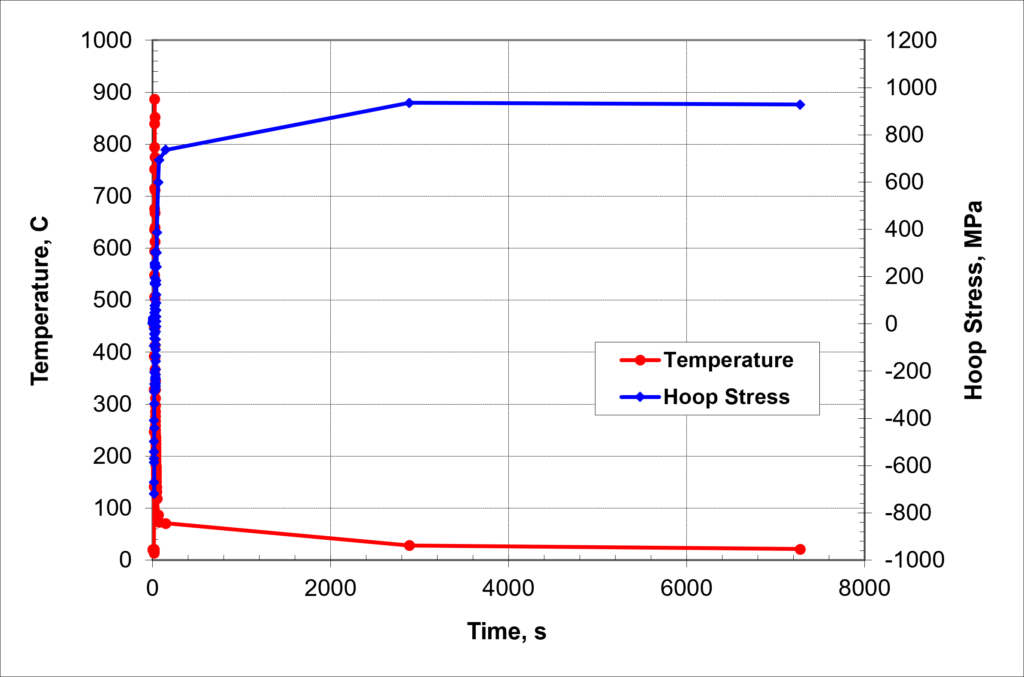
Notice the high stress at the location of cracking
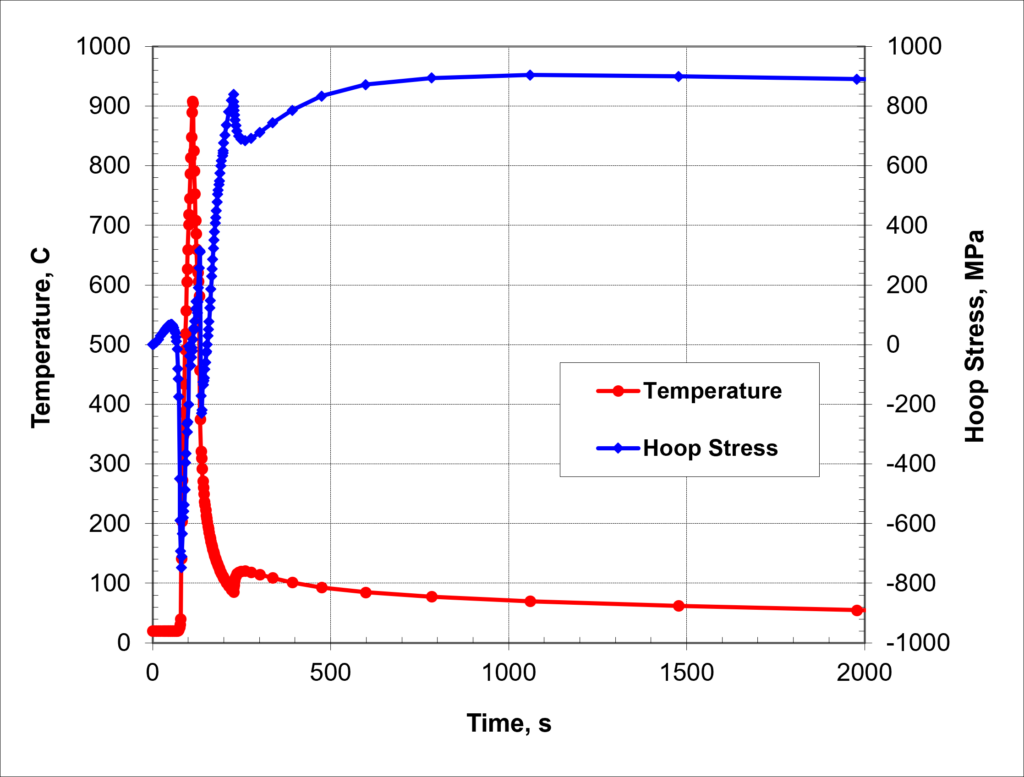
The maximum principal stress along the corner fillet is mainly in the hoop direction
This relates directly to the cracking mode observed
The strength of martensite with 0.4% carbon is around 1300 MPa.
The part surface may crack at stresses below the material strength; this is especially true for a brittle material such as as-quenched martensite
This phenomenon can be related to the surface roughness, micro-defects, etc.
The casing will most likely experience surface cracking if the maximum surface stress exceeds 900 MPa.
At stress levels below 650MPa, cracking will most likely not occur.
Alternative Processes
Two alternative processing routes were determined to be viable methods to eliminate the cracking issues:
1.Shallower hardened case
Reduce case depth to 0.120 inches
There will be less of a bending effect due to the reduced depth and amount of delayed martensite transformation
2.Preheating before induction hardening
Preheat to 500° F
Thermal shrinkage from the preheat temperature after quenching helps relieve the surface tension created by the quenching process
Preheating can be accomplished in a furnace or by using a low frequency – low power induction process
Results: Reduced Case Depth
A shallower case can be achieved by using higher frequency, higher power, and a faster scanning speed
Modeling results showed that the predicted stress is approximately the same for these processing conditions as for the current hardening process and thicker hardened case
Reducing the case depth was not a solution for this part
This was a significant finding, saving time and money by eliminating a physical test
Results: Preheat
The second option is to preheat the part to 500° F before induction hardening
Preheating can be done either by low frequency induction heating or by furnace heating
Induction preheating has some advantages over the furnace preheating, which can also be modeled by DANTE
To test the feasibility of a preheating approach, a uniform preheating temperature of 500° F by furnace was assumed
Preheat temperature can also be optimized using DANTE
Due to the higher initial temperature, the power used for induction hardening was reduced in order to produce a similar case depth as the original process
The power applied in the model was 70% of the power from the original process, and all other parameters were kept the same
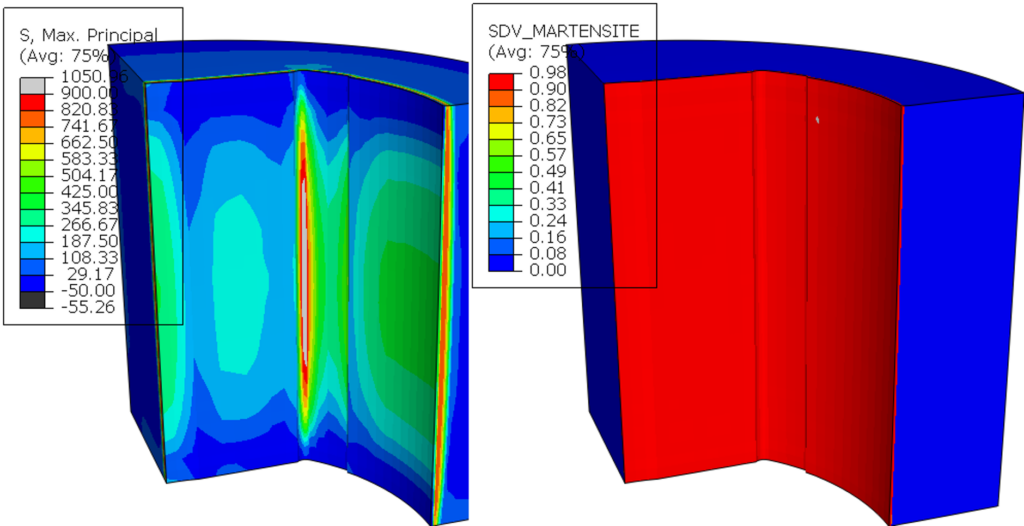
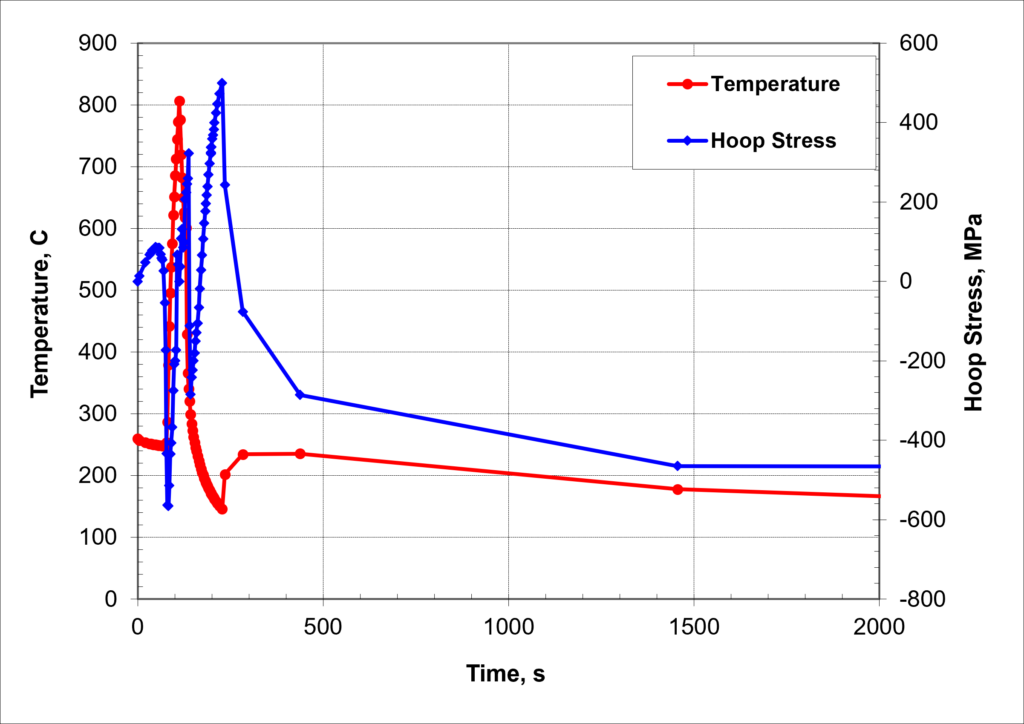
After quenching, the corner fillet reached the highest stress of approximately 550 MPa, as shown in the figures
With a 550 MPa tensile stress, it was estimated that cracking should not occur
Summary
Three scenarios of the induction hardening process for the casing part have been modeled using the DANTE heat treatment simulation software
the original process
a shallower hardened case
preheating the casing to 500° F before induction hardening
The DANTE model of the original case was found to effectively capture the cracking location and reasons for cracking
The modeling results from the shallower hardened case suggested that this approach was not able to solve the cracking problem
Preheating the casing to 500° F was predicted to effectively solve the corner cracking problem
In addition, the preheating can change an unfavorable residual tensile stress in the corner for the current process to a favorable compressive residual stress
Get hands-on experience with DANTE. Our student and trial license offers full access to heat treatment modeling tools so you can learn, experiment, and explore real-world simulations.