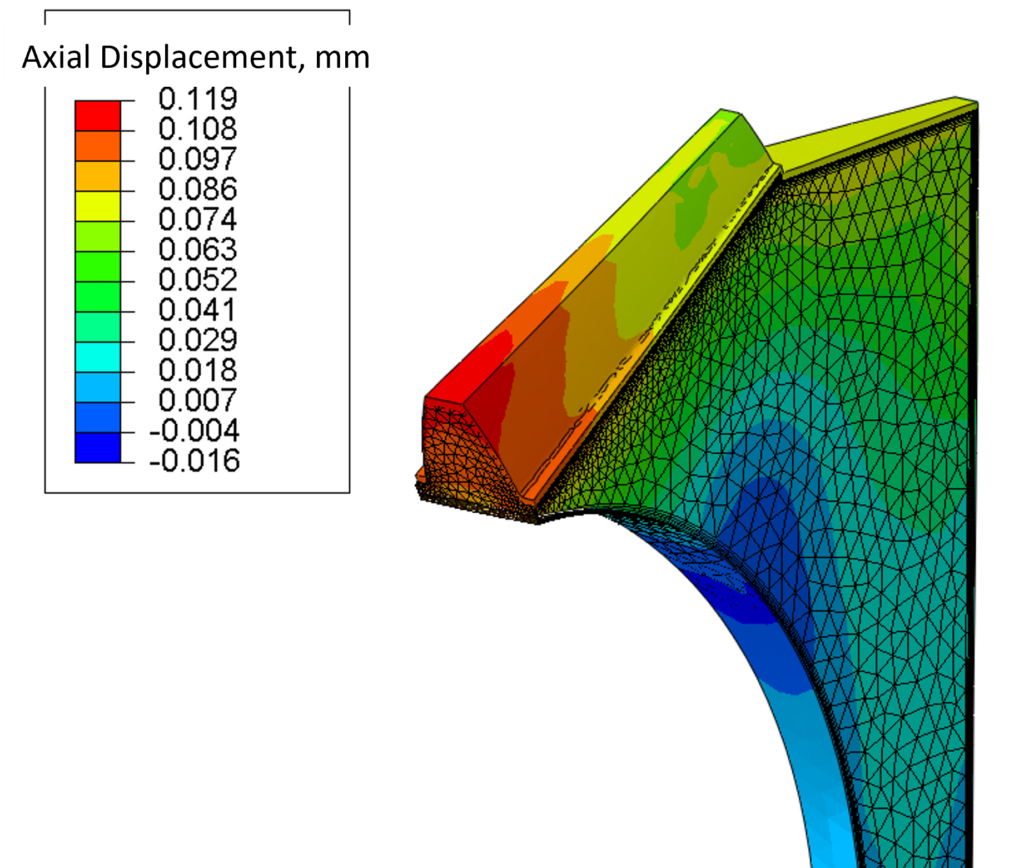
Nonuniform and excessive distortion of the tooth in the axial direction during oil quenching
Machining to correct distortion removes residual compressive stresses, damaging the fatigue performance
Problem not discovered until after production began. Cost to correct at this stage is very high
Bevel Gear Geometry
Number of Teeth: 40
Bore: 37.6 mm
Outer Diameter: 205 mm
Axial Length: 94.1 mm
Model Description
Single tooth used to model distortion of tooth. Assumes quenching power (i.e., heat transfer coefficient) is uniform on all gear surfaces and each tooth behaves the same. Sufficient to examine warpage of the gear tooth.
Meshing near surface is finer than in the core to capture carbon, thermal, phase transformation, and stress gradients
Single tooth CAD model
Meshing inside tooth
Process Description and Results
Carburize
Transfer to quench tank
Quench in oil
Cool to room temperature
Martensite, Vol. Frac.
Retained Austenite, Vol. Frac.
Carbon, Wt. Frac.
Hardness, HRC
Solutions
DANTE can be used as a troubleshooting tool, but using DANTE during the design stage to evaluate distortion during heat treatment is even more beneficial
Many problems resulting from heat treatment can be discovered and corrected before pre-production trials or production begins
Substantial cost savings can be realized by needing less trials to dial in the proper heat treatment schedule
During the design stage, two paths to correct the distortion are possible:
1.Change the geometry based on current process parameters to reduce distortion
Add material to the heat treat shape to increase stiffness of the gear tooth
Material can be removed after hardening if needed, but compressive stresses in tooth remain for enhanced fatigue performance
2.Change the process based on the current geometry to reduce distortion
Use a process which offers better dimensional stability
Geometry Change
New geometry added material to stiffen the gear tooth during quenching
Material can be removed after hardening, if needed
Overall distortion of the tooth tip reduced by 223 μm
Reduced difference by 176.4 μm over original geometry
Less machining of the gear tooth is needed, improving fatigue resistance by not machining off the beneficial residual compressive stresses
Process Change
Process:
Preheat part using induction heating
Austenitize using induction heating
Spray quench using a polymer solution
Equivalent case depth was obtained compared to carburization/oil quench process
Results
Overall distortion of the tooth tip reduced by 297.6 μm
Reduced difference by 166.5 μm over original geometry
Less machining of the gear tooth is needed, improving fatigue resistance by not machining off the beneficial residual compressive stresses
Summary
Difficult to quench bevel gear geometry showed excessive distortion of the gear tooth after a carburizing/ oil quenching process
Machining after the process to correct the distortion removed compressive stresses, damaging the fatigue performance
DANTE was used to explore changes to correct the fatigue performance
Change the heat treat geometry to improve stiffness of the tooth
Change to a process with better dimensional stability (press quenching is also an option, which can be modeled with DANTE)
Cost savings can be realized if the analysis is done before pre-production trials or production begins
Get hands-on experience with DANTE. Our student and trial license offers full access to heat treatment modeling tools so you can learn, experiment, and explore real-world simulations.